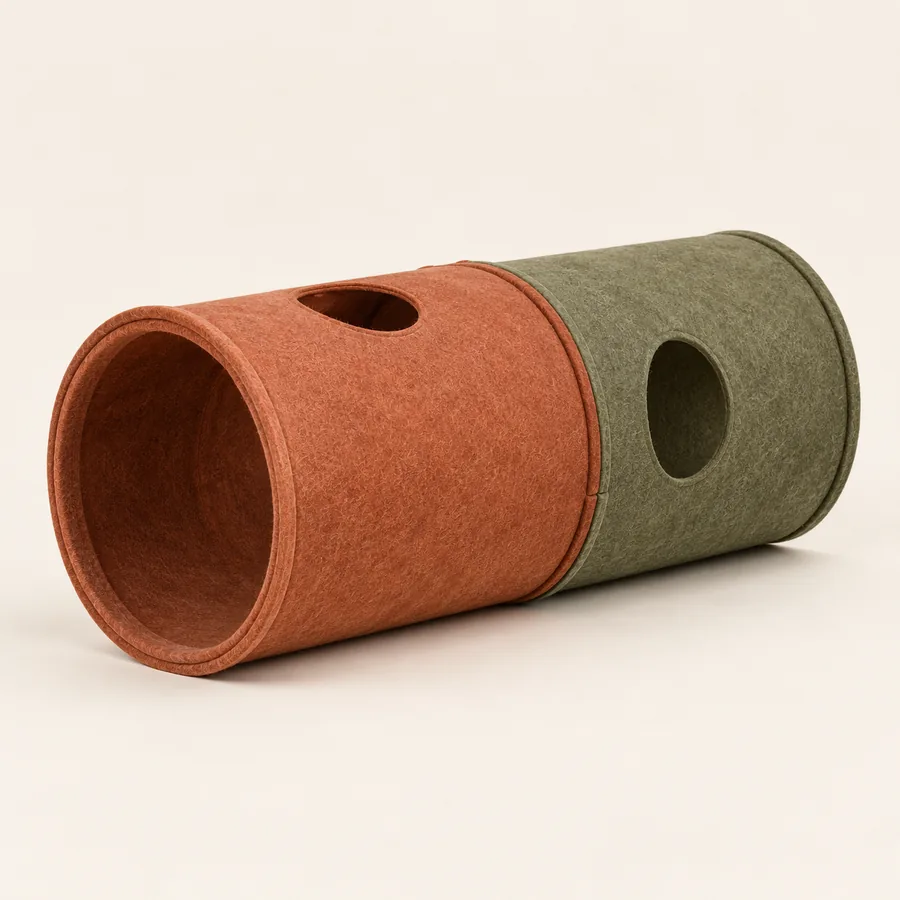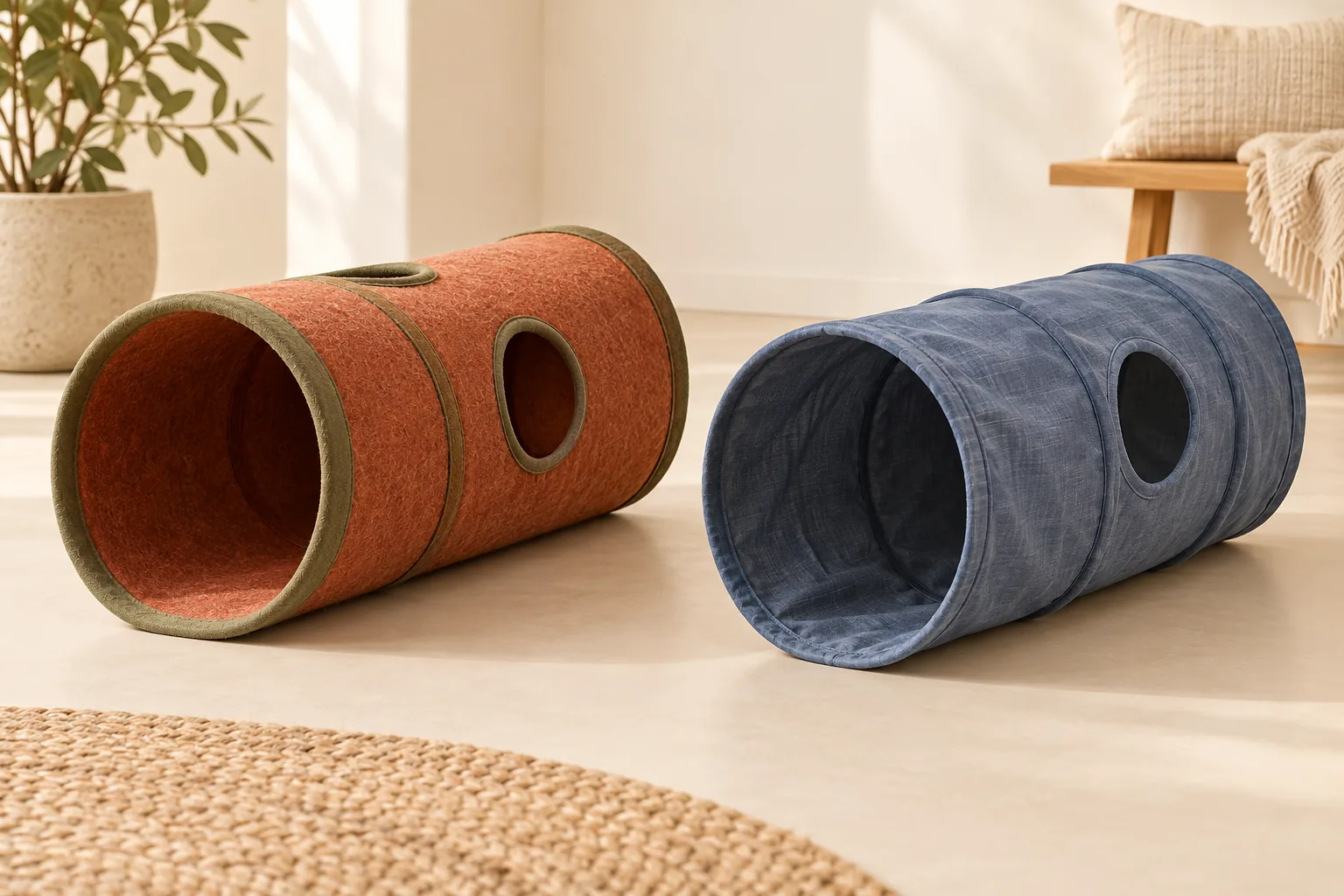
Choose a felt cat tunnel when a defined panel form and coordinated home presentation are central to your brief. Compare a flexible fabric tunnel when folding and repeated storage are central. Neither material name establishes durability, safety or cleaning performance: those depend on the actual construction and need to be checked on a sample.
This comparison is for pet brands and retailers selecting an indoor tunnel format. Here, “fabric tunnel” means a flexible woven or knitted shell with a supporting structure; felt is also a textile, but the comparison separates felt-panel designs from flexible cloth designs. All three images are newly generated concept illustrations, not tested samples or photos of supplied products.
What is the main structural difference?
A felt-panel tunnel uses the specified panel thickness, shape and connections as part of its body construction. A flexible cloth tunnel pairs its shell with another support arrangement, such as enclosed hoops. The important buying question is how the complete structure holds its passage open, rather than how thick or soft the visible surface looks.
For a felt brief, MewToys A01 is a starting point for discussing sections, openings, binding and connection details. The fabric designs in this article are generic alternatives for comparison, not an additional MewToys product offering.
| Buying consideration | Felt-panel design | Flexible fabric design | What to verify |
|---|---|---|---|
| Body and support | Panel form, joins and edge construction contribute to the structure | Shell and its support channels work together | Open passage, shape recovery and assembly |
| Visual direction | Panel surfaces, cut openings and binding can define the appearance | Weave, print, seams and support layout can define the appearance | Finished colors and details, not only a swatch |
| Storage | May separate into sections if designed to do so | May fold if its support system is designed to collapse | The specific folding or separating method |
| Care | Depends on fiber, finish, seams and connectors | Depends on shell, lining, support and attachments | Instructions for the complete product |
| Packaging | Must protect the selected shape or separated sections | Must retain the folded structure where applicable | Actual packed dimensions and unpacking sequence |
The table describes design approaches, not a ranking of all tunnels in either category. A thin felt shell and a thick lined fabric tunnel can behave differently from the illustrations. Compare written specifications before comparing claims.
Which design fits a home-focused collection?
Consider whether the customer expects the tunnel to remain in the room or to be put away after play. A felt-panel product can be explored through a defined silhouette, bound edges and a limited palette. A woven-fabric product can also support a coordinated home aesthetic; fabric does not automatically mean a bright novelty design.
For a useful market example, Catit’s Vesper Play Furniture page describes a fabric tunnel and foldable play furniture. This shows that a fabric construction can be positioned around home presentation and storage. Its stated features apply to the named range, not every fabric tunnel or a MewToys item.
Ask for an assembled sample and review it in the intended setting. Consider footprint, entrance visibility, colors under consistent lighting and where seams or joins appear. A generated room scene can communicate direction, but cannot establish the final finish or how the structure behaves on a floor.
How should openings and supporting parts be compared?
Compare usable entrance clearance, the narrowest passage and side-opening layout on both designs. External width includes construction that may not be available to the cat. A longer tunnel can still have a restricted entrance or a poorly aligned section connection.
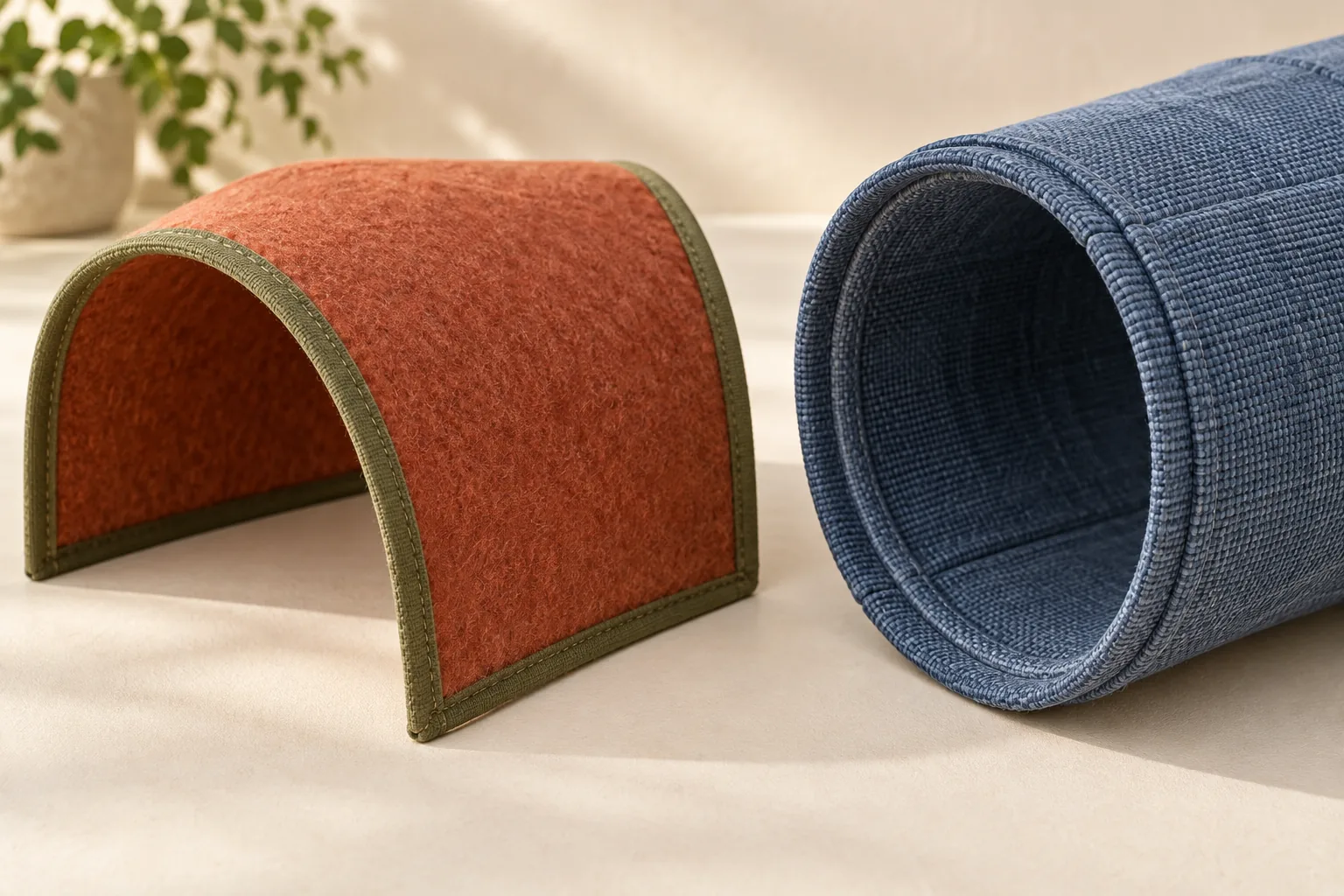
Construction illustration: the felt panel and enclosed fabric support are examples. Actual joints, thickness and support details must be confirmed on the selected sample.
For a felt-panel sample, inspect opening edges, binding, seams and how sections align. For a supported fabric sample, inspect support-channel stitching, end containment and the folding arrangement. If an attachment is included, assess that component separately; it is not automatically covered by the shell material description.
The FelineVMA environmental guidance identifies safe places and opportunities for play as parts of a cat’s environment. It provides general context for product selection, not a safety endorsement of a tunnel. Avoid promising suitability for every cat or using an indoor play tube as an outdoor containment system.
Is a fabric tunnel always easier to store?
Only if the actual design has a confirmed folding method. Ask how the support collapses, how the folded product is secured and how it returns to the open state. A product described as “fabric” may still contain a base or parts that determine its packed volume.
Likewise, “detachable felt tunnel” does not mean “flat-pack tunnel.” Separate cylindrical sections can remain bulky. Confirm whether the approved structure separates, nests or lies flat, and do not infer a packing method from a product image.
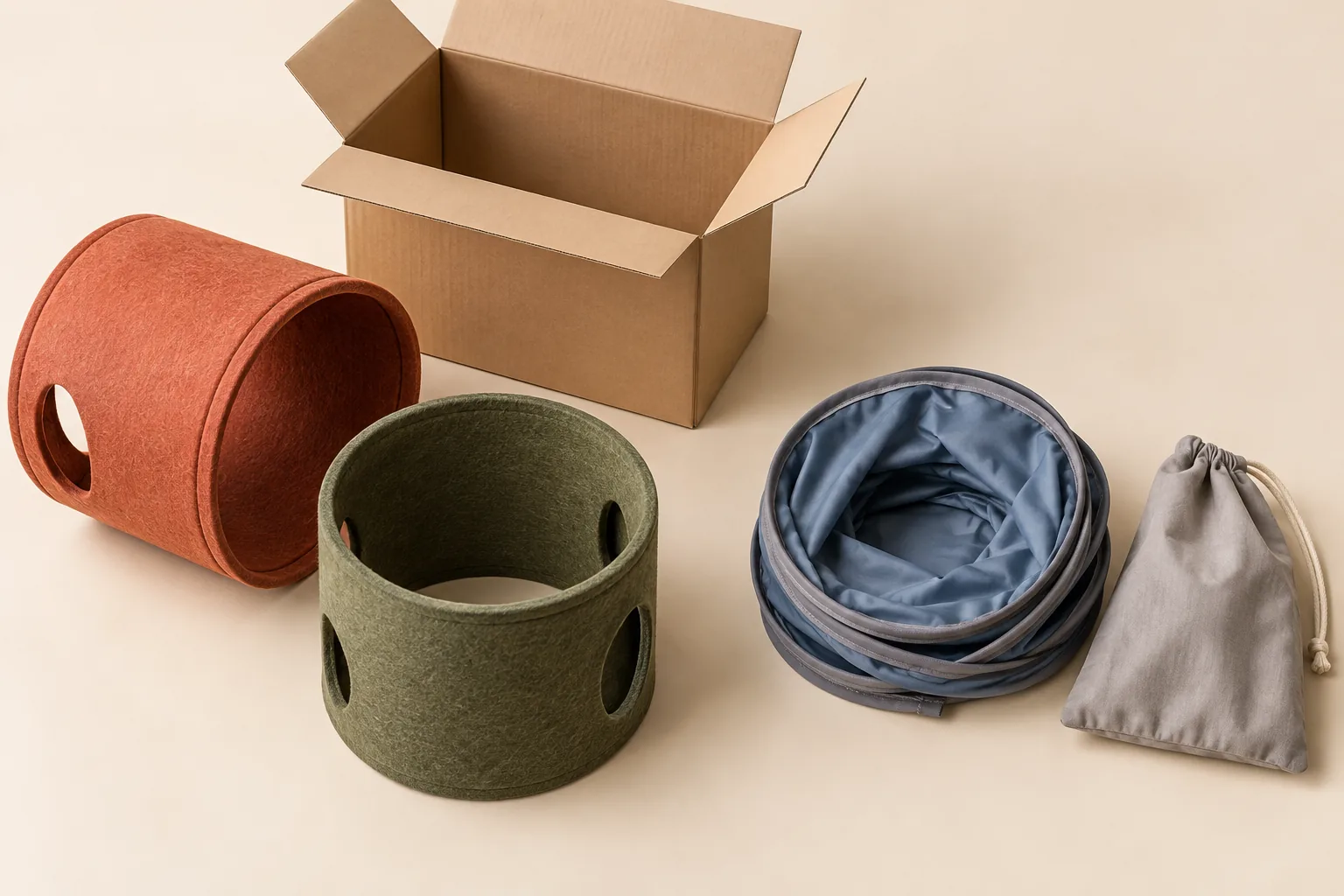
Packing illustration: these are possible design approaches, not measured pack sizes or proof of a shipping saving.
Compare one finished retail pack for each proposal. Record its dimensions, weight, units per master carton, assembly card and retained parts. Check the sample after unpacking using the agreed storage conditions. These measurements make the quotation more useful than an unqualified “space-saving” label.
Which material is easier to clean?
The material name alone does not answer that question. Specify fiber composition, lining, surface finish and removable parts. Then obtain a care method that accounts for connectors and support components as well as the visible shell.
For example, Catit’s Vesper Tunnel help page provides access to maintenance information for the named product. If a product-specific care instruction is unavailable, ask for clarification before publishing washing claims. Do not transfer instructions from one branded tunnel to another construction.
During the sample review, use only the agreed care method and record changes in shape, finish or connections. Do not publish “machine washable,” “hair resistant” or “quick drying” because the surface looks suitable. Our material specification guide explains which composition and construction fields to request.
Which approach is better for private label development?
Choose the starting structure around the product requirement, then compare the changes needed to express your brand. A label, a palette adjustment and a new support system are different scopes, even if the supplier calls all of them customization.
| Project goal | Details to discuss | Approval record |
|---|---|---|
| A coordinated felt range | Panel composition, colors, binding, openings and label position | Finished sample and material/color references |
| A fold-away cloth format | Shell, support channels, fold method and pack retention | Open and folded sample with instructions |
| A revised functional structure | The specific clearance, join or support requirement | Versioned drawing and revised physical sample |
No general material comparison can establish the cheaper option. Request quotes with equivalent quantity, usable size, included components and packaging. Confirm any development and sample charges separately. See the private label guide and first-order planning guide for controlling changes and versions.
What should a side-by-side sample review include?
- Name the exact construction, revision and intended use of each tunnel.
- Measure entrances, narrowest clearance, side openings and footprint.
- Assemble, separate or fold using the actual instructions.
- Inspect edges, joins, support channels and accessible loose components.
- Apply the confirmed care method and record observations.
- Measure the completed pack and identify its full contents.
- Compare quoted quantities, customization and included work.
- Record unresolved decisions before selecting the production version.
Use the sample approval guide to organize measurements and revisions. Keep visual observations separate from test results; if a performance claim matters to the project, agree how it will be substantiated.
Buyer questions about felt and fabric tunnels
Is felt always more durable than fabric?
No such conclusion follows from the names alone. Fiber, thickness, seams, joins, supports and use conditions differ. Compare the specified constructions and agreed sample evidence rather than claiming a universal winner.
Do all fabric tunnels make a crinkling sound?
Do not assume this. Ask whether the selected construction includes a crinkle layer or another sound-producing component, then assess the sample. Woven fabric by itself is not a specification for that feature.
Can a detachable felt tunnel use a smaller shipping pack?
That depends on how its parts pack and the comparison version. Request measurements of both finished packs. Detachability alone does not establish smaller volume or lower freight.
Start with a specification, then select the format
Write down the intended setting, usable opening, storage method, care expectations, quantity and branding needs. For the MewToys felt range, explore A01 or the Explore category, then use the RFQ guide to request specifications and sample arrangements. The selected sample should resolve the questions the material label cannot answer.
Share your selected SKUs, market and customization ideas. Discuss product specifications, packaging and sample arrangements for your collection.
Start an inquiry ↗